
Cradle of a Railroad Town’s 150-Year Legacy
Published ahead of the Allen 150 Sesquicentennial — April 25, 2026
Picture North Texas in the summer of 1874: open prairie, scattered post oak, and a creek called Cottonwood winding south through land that had no town, no post office, and no particular reason to become one. Then the steam engines came.
The Houston & Texas Central Railway was pushing north—Houston to Dallas to Denison, threading the state together mile by dusty mile. And every ten miles or so, those engines needed water. A lot of it. The H&TC’s solution at Cottonwood Creek was to build something that has outlasted everything else from that era: a hand-cut stone dam, 69 feet long and 10 feet high, holding back enough water to keep the trains running through the night. Workers from Ireland, Germany, and Switzerland hauled and fitted those blocks, raised a pump house, and anchored an elevated tank on stone piers beside the tracks. In a matter of months, a creek ford became a working infrastructure node on one of the most important rail corridors in the South.
Within two years, surveyor Theodore Kosse—the H&TC’s chief engineer, whose name already graced a stop in Limestone County he had platted earlier in the line’s push northward—laid out a town plat here and called it Allen. The water station hadn’t just served the railroad. It had seeded a city.
One hundred and fifty years later, that city is throwing a party. And the stone dam is still there.
Railroad Roots in 1874
The H&TC was one of the defining infrastructure projects of post-Civil War Texas, stitching together the cotton, grain, and cattle economy from the Gulf Coast to the Red River. Steam locomotives of that era were thirsty machines—a typical engine could consume several thousand gallons on a hard run—which meant the railroad needed dependable water sources spaced roughly every ten miles along its route.
Cottonwood Creek offered what the engineers needed: reliable flow, accessible terrain, and stone close enough to work with. The resulting dam was no improvised fix. Cut from native limestone and fitted without mortar in the dry-stack tradition, the 69-foot structure held a sluice gate that controlled flow into the holding pool. A pump house drew from that pool and pushed water up to an elevated tank on stone piers positioned directly beside the tracks, where a tender could fill a locomotive boiler during a scheduled stop. The whole system was designed for speed and reliability—two things the railroad absolutely required.

The 1874 stone dam on Cottonwood Creek — 69 feet long, 10 feet high, hand-cut from native limestone. It is believed to be one of the only stone dams in the United States built solely to serve railroad operations.
The crew that built and ran this station was as international as the trade it served. Immigrant workers from Ireland, Germany, and Switzerland settled near the site, and the small community that formed around the water stop quickly attracted the merchants, tradespeople, and families that follow any reliable economic anchor. Theodore Kosse formalized that reality when he surveyed and platted the town in 1876, giving Allen its name and its first street grid. The water station was not just infrastructure—it was the reason a city exists where one does today.
Survival Through Expansion and Decline
Growth has a way of outpacing its origins. By 1912, rail traffic through Allen had increased enough that the original 1874 dam couldn’t keep up. The H&TC’s solution was a taller concrete dam built downstream, which raised the water level enough to submerge most of the original stonework under a larger reservoir. Upgraded pumps drawing from iron intake pipes replaced the earlier system. The station kept working; the 1874 dam just disappeared beneath the surface.
The next major shift came after World War II, when diesel locomotives steadily replaced steam across American railroads. Diesel engines don’t need water stops every ten miles—they need fuel. By the late 1940s, the water station at Cottonwood Creek had gone from essential infrastructure to a relic nobody needed anymore. The pumps fell silent. The buildings sat idle.
The original H&TC rail grade at the Allen Water Station site. These weathered rails mark the path that steam locomotives traveled for decades, pausing here to take on water before continuing north or south

Then the floods came. The 1912 concrete dam took water damage through the 1960s and eventually failed. Its remnants were cleared during construction of Exchange Parkway in the 1990s—and that demolition work did something unexpected. It re-exposed the original 1874 stonework, which had been sitting quietly underwater for the better part of a century. The foundations of the elevated tank, the pump house, and the 1910 bridge also survived. What looked like a forgotten corner of a city park turned out to be a remarkably intact piece of industrial history.
Modern Revival and 150th Tie-In
Once historians and preservationists got a close look at what had been uncovered, the significance of the site became clear. The Allen Water Station was added to the National Register of Historic Places and designated a State Antiquities Landmark—formal recognition that this was worth protecting and interpreting, not just leaving to weather.
Today the site is a genuine destination. Walking trails run along Cottonwood Creek. Interpretive signs explain what each surviving foundation and structure actually was. The National Register plaque anchors the experience, giving visitors the full context of what they’re standing in front of. The Allen Heritage Guild and the city’s Parks Department have worked together to keep the site accessible and informative, and it serves as a natural connection point between Allen’s founding story and the present city.
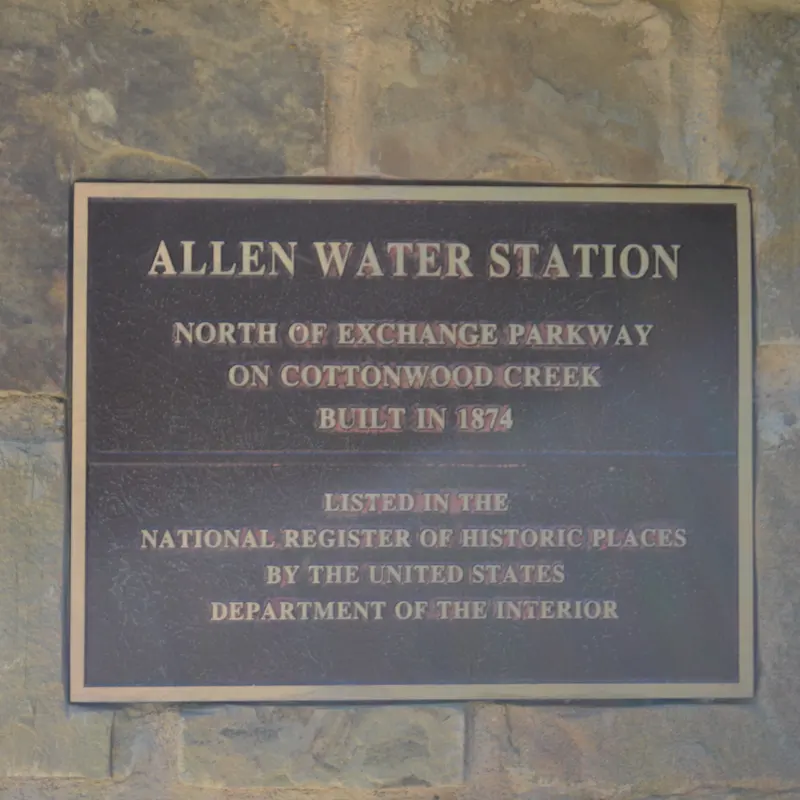
The National Register of Historic Places plaque at the Allen Water Station. The site also carries State Antiquities Landmark designation, one of the stronger protective classifications in Texas historic preservation.
That connection becomes especially pointed this spring. On April 25, 2026, the city marks its sesquicentennial with Allen 150 Fest at the nearby historic depot replica—a full day of events tying Allen’s founding to its present. The Water Station sits just upstream from that celebration, literally and historically. The 1874 dam that made the town possible will still be there when the drone show lights up the sky that evening.
Why It Matters at 150
Allen’s growth arc is genuinely remarkable: a railroad water stop platted in 1876 is now a suburb of more than 100,000 people, consistently ranked among the safest and most livable cities in the country. That kind of trajectory invites reflection on what the starting point actually was.
The Water Station is that starting point. It is believed to be one of the only stone dams in the United States built solely to serve railroad operations—not irrigation, not flood control, not municipal supply, but steam engines running cotton and cattle north to market. Without it, or something like it, the H&TC survey crew would have put a water stop somewhere else, and whatever settlement formed there would have gotten the town plat and the name.
What makes the site worth visiting—and worth writing about—is that it isn’t reconstructed or re-created. The stone is original. The grade is original. The dam that immigrants cut and stacked in 1874 is the same dam you can walk up to today, 150 years later. That kind of direct physical continuity with founding events is rare in any American city, and it’s worth the short walk from the parking area at Cottonwood Creek Parkway to go see it before the sesquicentennial weekend.
References
Texas Historical Markers: Allen Water Station — texashistoricalmarkers.weebly.com
Allen Heritage Guild: Stone Dam & Water Station — allenheritage.org
Texas Historical Commission NRHP Nomination: Allen Water Station (2009) — atlas.thc.texas.gov
Wikipedia: Allen Water Station — en.wikipedia.org
Wikipedia: Kosse, Texas (Theodore Kosse / H&TC chief engineer) — en.wikipedia.org
City of Allen 150th Updates — cityofallen.org
This article originally appeared on texastales.info. Used with permission. Images provided by Allen resident D. Allen.